


Nissan Frontier: Technical and consumer information - Truck-camper loading information
Basic information
Do not use a slide-in camper with your Nissan Frontier.
Special Body vehicles
Some Nissan Frontier vehicles may be equipped with commercial bodies, utility bodies, or camper-type body installations. However, these configurations are not covered in this Owner's Manual.
For complete and accurate operating, loading, and safety information, always refer to the instruction manual supplied by the body manufacturer.
Location for center of gravity
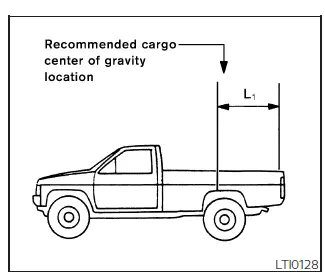
The illustration shows the recommended location for the cargo center of gravity when loading the Nissan Frontier. Correct load placement is important for stable handling, proper braking, and balanced axle weight distribution.
King Cab:
Short wheel base models without bedliner/tailgate liner,
L1 = 41.1 in (1,045 mm)
Short wheel base models with bed liner/ tailgate liner (SV/PRO-4X with comfort and convenience package),
L1 = 40.5 in (1,028 mm)
Crew Cab:
Short wheel base models without bedliner/ tailgate liner,
L1 = 41.1 in (1,045 mm)
Short wheel base models with bedliner/ tailgate liner (SV/PRO-4X with comfort and convenience package),
L1 = 40.5 in (1,028 mm)
Long wheel base models,
L1 = 40.6 in (1,032 mm)
WARNING
- Incorrect loading can create a dangerous driving condition.
If the load is positioned too far toward the rear of the Nissan Frontier, vehicle handling and stability may be affected. If the load is placed too far forward, the front axle may be overloaded.
- Overloading or improper weight distribution can negatively affect steering response, braking distance, vehicle performance, and overall control, which may lead to an accident.
Vehicle load weight capacity
The vehicle payload weight capacity shown on the Tire and Loading Information label identifies the maximum total weight that your Nissan Frontier is designed to carry. This includes passengers, optional equipment such as air conditioning or a trailer hitch, and all cargo placed in or on the vehicle.
Before driving the Nissan Frontier with any load, confirm that the Gross Vehicle Weight Rating (GVWR) and Gross Axle Weight Rating (GAWR) are not exceeded.
Also check all tires for proper inflation pressure before driving, especially when the vehicle is carrying cargo or additional equipment.