



Nissan Frontier: Technical and consumer information - Vehicle loading information
Basic information Nissan Frontier 3rd Gen
WARNING
- Never permit any person to ride in the cargo area of the Nissan Frontier or on rear seats that are folded down. During a collision, occupants in these locations do not have the protection of a properly designed seating position and restraint system, which greatly increases the risk of serious injury or death.
- Riding in a cargo area inside a vehicle is extremely dangerous and must never be allowed.
In a crash, sudden stop, or rollover, anyone riding in these areas is far more likely to be seriously injured or killed because the space is not designed for passenger protection.
- Do not allow passengers to ride in any part of your Nissan Frontier that is not equipped with approved seats and properly functioning seat belts.
- Always make sure every occupant in the vehicle is seated correctly and using a seat belt properly before the Nissan Frontier is driven.
Terms
Before loading your Nissan Frontier, it is important to understand the following weight and capacity terms. These definitions help you load the vehicle safely, avoid overloading, and maintain proper handling, braking, and tire performance.
- Curb Weight (actual weight of your vehicle) - the weight of the vehicle including standard equipment, optional equipment, required fluids, emergency tools, and the spare tire assembly. This weight does not include passengers or cargo added to the Nissan Frontier.
- GVW (Gross Vehicle Weight) - the curb weight of the vehicle plus the combined weight of all passengers and all cargo being carried.
- GVWR (Gross Vehicle Weight Rating) - the maximum permitted total combined weight of the unloaded vehicle, occupants, cargo, hitch equipment, trailer tongue load, and any optional equipment installed on the Nissan Frontier. This information is listed on the F.M.V.S.S./C.M.V.S.S. certification label.
- GAWR (Gross Axle Weight Rating) - the maximum weight, or load limit, specified for either the front axle
or the rear axle.
This rating is shown on the F.M.V.S.S./C.M.V.S.S. certification label and should never be exceeded when the Nissan Frontier is loaded.
- GCWR (Gross Combined Weight Rating) - the maximum allowable combined weight rating of the vehicle, passengers, cargo, and trailer when towing.
- Vehicle Capacity Weight, Load limit, Total load capacity - the maximum total weight limit specified for
the load carried by the vehicle, including passengers and cargo.
This is the maximum combined weight of occupants and cargo that may be loaded into the vehicle. If the Nissan Frontier is used to tow a trailer, the trailer tongue weight must be counted as part of the cargo load. This information is provided on the Tire and Loading Information label.
- Cargo capacity - the permissible weight of cargo that can be carried after subtracting the weight of all occupants from the vehicle load limit.
Vehicle load capacity Nissan Frontier SUV
Basic information
Before driving your Nissan Frontier with passengers, cargo, or towing equipment, confirm that the Gross Vehicle Weight Rating (GVWR) and the Gross Axle Weight Rating (GAWR) are not exceeded. Both the GVWR and GAWR are located on the F.M.V.S.S./C.M.V.S.S. certification label.
Do not exceed the vehicle load limit shown as "The combined weight of occupants and cargo" on the Tire and Loading Information label. This value is the safe maximum for the combined weight of people and cargo inside or on the vehicle.
Do not exceed the number of occupants shown as "Seating Capacity" on the Tire and Loading Information label. Carrying more passengers than the approved seating positions can reduce safety and may overload the vehicle.
To determine "the combined weight of occupants and cargo", add the weight of all occupants, then add the total weight of the cargo. The following illustration provides an example of how this calculation is applied to the Nissan Frontier.
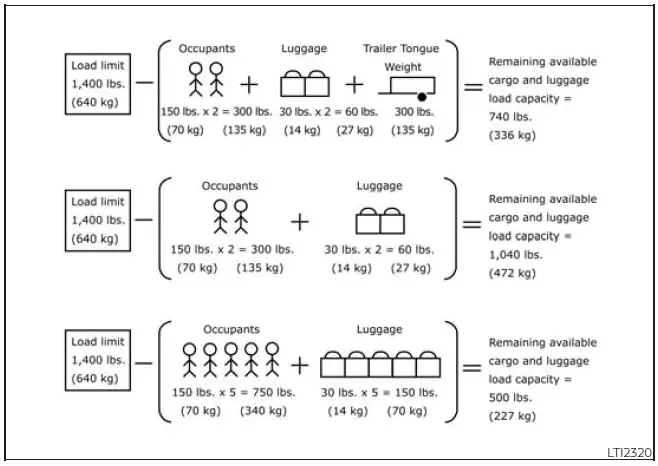
Example
Steps For Determining Correct Load Limit
1. Find the statement "The combined weight of occupants and cargo should never exceed XXX kg or XXX lbs." on your vehicle's placard.
2. Determine the combined weight of the driver and all passengers who will be riding in the Nissan Frontier.
3. Subtract the combined weight of the driver and passengers from XXX kg or XXX lbs.
4. The resulting number is the available amount of cargo and luggage load capacity. For example, if the "XXX" amount equals 1400 lbs. and five passengers weighing 150 lbs. each will ride in the vehicle, the available cargo and luggage load capacity is 650 lbs. (1400 - 750 (5 x 150) = 650 lbs.) 5. Determine the combined weight of luggage and cargo being loaded into or onto the vehicle. That total must not safely exceed the available cargo and luggage load capacity calculated in step 4.
6. If the Nissan Frontier will be used to tow a trailer, part of the trailer load will be transferred to the vehicle through the trailer tongue. Consult this manual to determine how towing reduces the available cargo and luggage load capacity of your vehicle.
Before driving a loaded Nissan Frontier, confirm again that the GVWR and the GAWR for the vehicle have not been exceeded.
Also check all tires for correct inflation pressures, especially when the truck is carrying heavy cargo or towing. Proper tire pressure helps support load capacity, handling stability, braking performance, and tire durability.
Securing the load
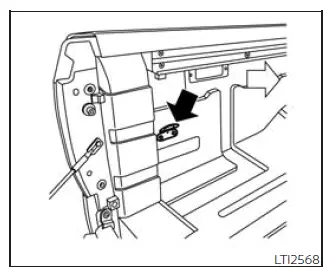
For convenience, tie-down hooks, if so equipped, are located at each corner of the truck box. These hooks can be used to help secure cargo carried in the Nissan Frontier truck bed and reduce the chance of the load sliding, tipping, or shifting while driving.
WARNING
- Always secure cargo properly with ropes, straps, or other suitable restraints to help prevent it from sliding or shifting. Do not stack cargo higher than the seatbacks. During a sudden stop, sharp turn, or collision, unsecured cargo can move forward or sideways and cause personal injury.
- Do not load your vehicle beyond the GVWR or the maximum front and rear GAWRs. Overloading the Nissan Frontier can damage vehicle components, increase tire wear or tire failure risk, and change the way the vehicle steers, brakes, and handles. This could lead to loss of control and personal injury.
Utili-track channel system Nissan Frontier 3rd Gen
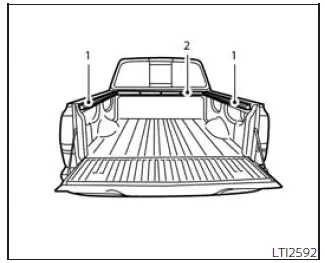
- Side channels
- Header channel
WARNING
- Always install and securely tighten the tie-down cleats in the Nissan Frontier Utili-track channel system before securing cargo. Never attach ropes, chains, or straps directly to the channel itself. Failure to correctly install the tie-down cleats or improper attachment of cargo restraints may allow cargo to shift or become loose. During sudden braking, evasive maneuvers, or a collision, unsecured cargo can cause serious personal injury or vehicle damage.
- All cargo carried in the Nissan Frontier truck bed must be properly secured using appropriate ropes, straps, or tie-down devices. Correct cargo restraint helps prevent shifting, sliding, or movement that could compromise vehicle stability and safety.
The Nissan Frontier Utili-track channel system is designed to provide flexible cargo management by allowing tie-down cleats to be repositioned throughout the truck bed. This enables you to secure different types and sizes of cargo at the most effective anchor points.
For proper operation, the tie-down cleats must be installed so that the clamp is fully seated within the channel notches. If the cleat is not properly engaged, it will not sit flush against the rail and cannot be tightened correctly. The center bolt of the tie-down cleat should be tightened by hand to 20 - 40 in-lbs. (2.27 - 4.6 N·m).
During long trips or when carrying heavy cargo, periodically inspect the tie-down cleats to verify that the center bolt remains secure and has not loosened due to vibration or cargo movement.
Install the tie-down cleat using the following procedure:
1. Remove the side channels by sliding them rearward and out of the truck bed.
Store the side channels carefully in a safe location to avoid damage.
2. Completely loosen the center bolt before inserting the tie-down cleat.
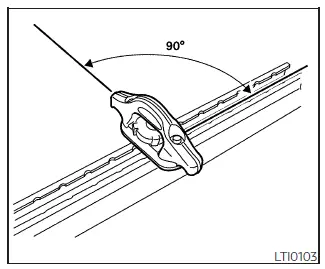
3. Insert the cleat into the channel so that it is perpendicular to the rail as illustrated. After insertion, rotate the cleat clockwise approximately 90 degrees and slide it along the channel to the desired securing position.
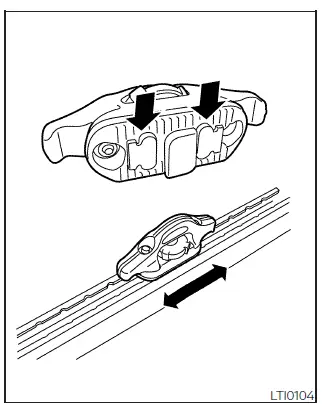
4. Position the cleat carefully so the locating nubs on the bottom of the cleat engage completely with the channel detents.
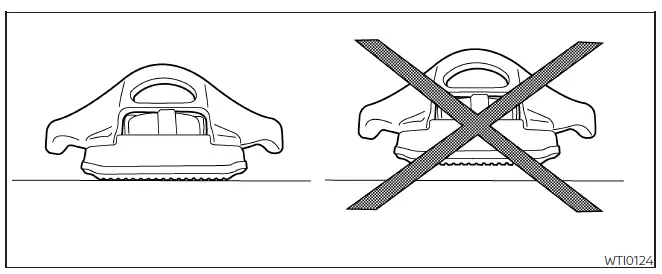
5. Verify that there is no visible gap between the bottom of the tie-down cleat and the top surface of the channel. Once properly seated, tighten the center bolt by hand to 20 - 40 in-lbs. (2.27 - 4.6 N·m).
CAUTION
- Only one tie-down cleat should be installed in each individual section of the channel system.
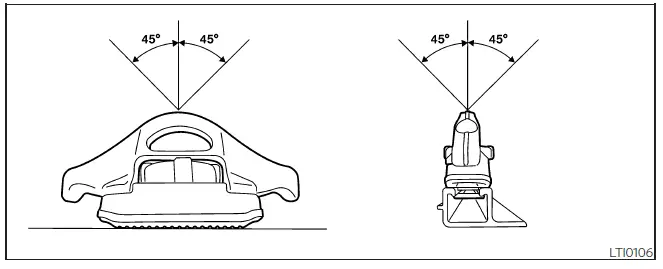
- Applying loads to the tie-down cleats at angles greater than 45° or exceeding 150 lbs. (204 N·m) in
the header and floor channels, or 200 lbs. (271 N·m) in the side channels, may damage the
Utili-track channel system or the truck bed structure.
Excessive force can reduce cargo-securing effectiveness and may require costly repairs.
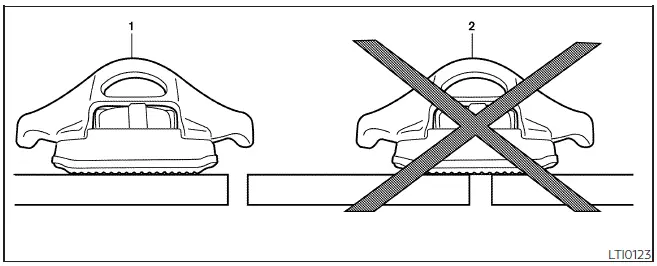
1 correct installation, 2 incorrect installation
WARNING
Do not install accessories across the gap between the front and rear side channels of the Nissan Frontier Utili-track system.
Doing so may interfere with the designed performance of the rear body structure during certain rear-impact collisions and could increase the risk of serious injury.
Loading tips
- The Gross Vehicle Weight (GVW) of your Nissan Frontier must never exceed the Gross Vehicle Weight Rating (GVWR) or the Gross Axle Weight Ratings (GAWR) listed on the F.M.V.S.S./C.M.V.S.S. certification label.
- Do not load either the front axle or the rear axle to its maximum GAWR individually, as doing so may result in exceeding the overall GVWR of the vehicle.
WARNING
- Secure all cargo properly using suitable ropes, straps, cargo nets, or tie-down devices. Never place cargo higher than the seatbacks. In a sudden stop, rollover, or collision, unsecured cargo can move unexpectedly and cause serious injury.
- Do not operate your Nissan Frontier when loaded beyond the specified GVWR or maximum front and rear
GAWR values. Excessive weight can damage suspension components, wheels, tires, brakes, and other
vehicle systems, while also affecting handling characteristics.
This may lead to loss of vehicle control and increase the risk of an accident resulting in injury.
- Overloading can significantly shorten the service life of your Nissan Frontier and its tires. It can also increase stopping distances, reduce steering response, and create unsafe driving conditions. Excessive loads may contribute to premature tire failure, which could result in a serious collision and personal injury. Damage or failures caused by overloading are not covered by the vehicle warranty.
Measurement of weights
Secure all loose items before weighing the vehicle to prevent weight shifts that could affect balance and measurement accuracy. After loading the Nissan Frontier, drive to a certified scale and measure the front and rear axle loads separately to determine the actual distribution of weight.
Individual axle loads must not exceed the applicable Gross Axle Weight Rating (GAWR). In addition, the combined total of both axle loads must remain below the Gross Vehicle Weight Rating (GVWR). These ratings are listed on the vehicle certification label. If any weight rating is exceeded, redistribute, relocate, or remove cargo until all measured weights fall within the approved limits. Maintaining proper weight distribution helps preserve the handling, braking performance, stability, and long-term durability of your Nissan Frontier.