


Nissan Frontier: Do-it-yourself - Wheels and tires
Tire pressure Nissan Frontier
Tire Pressure Monitoring System (TPMS)
WARNING
Radio waves may interfere with certain electric medical devices.
Anyone who uses a pacemaker or similar medical equipment should contact the device manufacturer before using the Nissan Frontier TPMS to confirm whether radio signals could affect the device.
This Nissan Frontier is equipped with a Tire Pressure Monitoring System (TPMS).
The TPMS monitors the air pressure in all road tires, but it does not monitor the spare tire. When the low tire pressure warning light comes on and the "Tire Pressure Low - Add Air" message appears in the vehicle information display, one or more tires are significantly under-inflated and require attention.
The TPMS operates only when the Nissan Frontier is driven at speeds above approximately 16 mph (25 km/h). The system may not detect a sudden or immediate loss of tire pressure, such as a flat tire that occurs while driving.
Tire inflation pressure
Check tire pressure frequently, including the spare tire, and always check it before long-distance driving. The recommended tire pressure specifications are shown on the F.M.V.S.S./C.M.V.S.S. certification label or on the Tire and Loading Information label under the "Cold Tire Pressure" heading. The Tire and Loading Information label is located on the driver-side center pillar.
Tire pressures should be checked regularly because:
- Most tires naturally lose air pressure over time.
- Tires may lose air suddenly after hitting potholes, road debris, curbs, or other hard objects while driving or parking.
Tire pressure should be checked only when the tires are cold. Tires are considered COLD after the Nissan Frontier has been parked for 3 hours or more, or after it has been driven less than 1 mile (1.6 km) at moderate speed.
The TPMS with Easy-Fill Tire Alert provides visual and audible signals outside the vehicle to help inflate tires to the recommended COLD tire pressure.
Incorrect tire pressure, including under-inflation, can reduce tire life, affect fuel economy, change handling behavior, and compromise Nissan Frontier driving stability.
WARNING
- Improperly inflated tires can fail suddenly and may cause an accident.
- The Gross Vehicle Weight Rating (GVWR) is listed on the F.M.V.S.S./C.M.V.S.S. certification label.
The vehicle weight capacity is shown on the Tire and Loading Information label.
Do not load the Nissan Frontier beyond this capacity. Overloading can reduce tire life, create unsafe operating conditions due to premature tire failure, negatively affect handling, and may lead to a serious accident.
Exceeding the specified load capacity may also cause failure or damage to other vehicle components.
- Before taking a long trip, or whenever the Nissan Frontier is carrying a heavy load, use an accurate tire pressure gauge to confirm that all tire pressures are set to the specified level.
- For additional tire safety information, refer to "Important Tire Safety Information" (US) or "Tire Safety Information" (Canada) in the Warranty Information Booklet.
Maintaining correct tire pressure helps the Nissan Frontier deliver safer handling, better braking response, improved tire durability, and more predictable performance in everyday driving, towing, and loaded conditions.
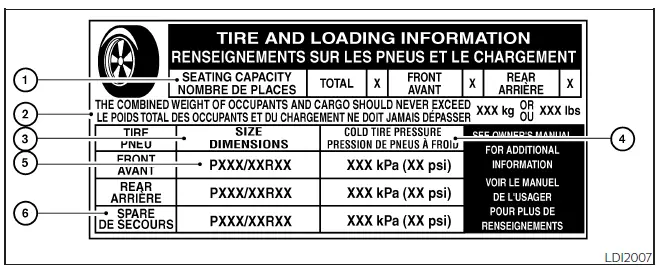
Tire and Loading Information label
- Seating capacity: This shows the maximum number of occupants that may be seated in the Nissan Frontier.
- Vehicle load limit: This indicates the maximum load the vehicle is designed to carry safely.
- Original tire size: This shows the tire size originally installed on the Nissan Frontier at the factory.
- Cold tire pressure: Inflate the tires to this pressure when the tires are cold. Tires are considered COLD after the Nissan Frontier has been parked for 3 hours or more, or after it has been driven less than 1 mile (1.6 km) at moderate speed. The recommended cold tire inflation pressure is set by the manufacturer to provide the best balance of tire wear, handling, ride comfort, drivability, road noise, and performance up to the vehicle’s GVWR.
- Tire size: This identifies the approved tire size information for the vehicle.
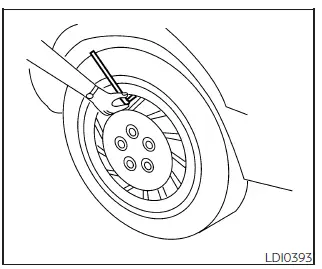
Checking tire pressure
1. Remove the valve stem cap from the tire.
2. Press the tire pressure gauge squarely onto the valve stem. Do not press too hard or push the valve stem sideways, as this may allow air to escape.
If you hear a hissing sound while checking tire pressure, air is leaking from the valve. Reposition the gauge straight onto the valve stem until the leakage stops.
3. Remove the gauge from the valve stem.
4. Read the tire pressure on the gauge stem and compare it with the specification shown on the F.M.V.S.S./C.M.V.S.S. certification label or the Nissan Frontier Tire and Loading Information label.
5. Add air to the tire if needed. If too much air is added, briefly press the valve stem core with the tip of the gauge stem to release pressure. Recheck the pressure and continue adding or releasing air until the correct specification is reached.
6. Install the valve stem cap securely.
7. Check the pressure of all other tires, including the spare tire.
Size/Cold Tire Inflation Pressure:
Front and Rear Original Tire
- P265/70R16 or 265/65R17 or
265/70R17
- 35 psi
- 240 kPa
Original Tire/Spare Tire Size
- P265/70R16
- Full Size
- 265/65R17
- P265/70R16
- 265/70R17
- Full Size
For accurate results, always check Nissan Frontier tire pressure before driving or after the tires have cooled fully. Correct cold tire pressure supports stable handling, even tire wear, proper load carrying, and safer driving performance.
Tire labeling Nissan Frontier third generation
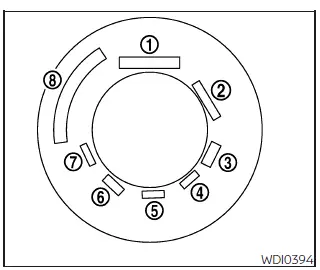
Example
Basic information
Federal law requires tire manufacturers to place standardized information on the sidewall of every tire. These markings help Nissan Frontier owners identify the tire size, construction type, load capability, speed rating, production date, and other important safety details.
This information describes the key characteristics of the tire and includes the Tire Identification Number (TIN), which is used for safety standard certification. The TIN can also help identify a tire if a recall or safety campaign is issued.
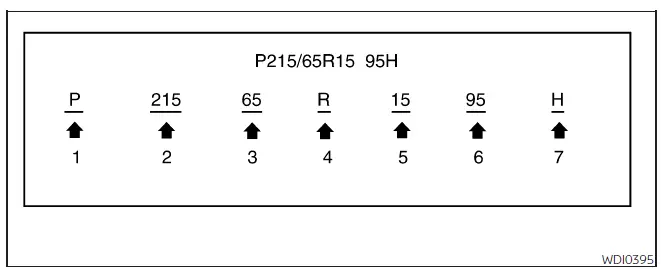
Example
- Tire size (example: P215/65R15 95H)
1. P: The "P" indicates that the tire is designed for passenger vehicles. Not all tires include this letter.
2. Three-digit number (215): This number indicates the tire width in millimeters, measured from one sidewall edge to the opposite sidewall edge.
3. Two-digit number (65): This number is the aspect ratio. It represents the tire sidewall height as a percentage of the tire width.
4. R: The "R" means the tire has radial construction.
5. Two-digit number (15): This number identifies the wheel or rim diameter in inches.
6. Two- or three-digit number (95): This number is the tire load index.
It indicates how much weight each tire is designed to support.
7. H: This letter identifies the tire speed rating. Do not drive the Nissan Frontier faster than the speed rating of the installed tires.
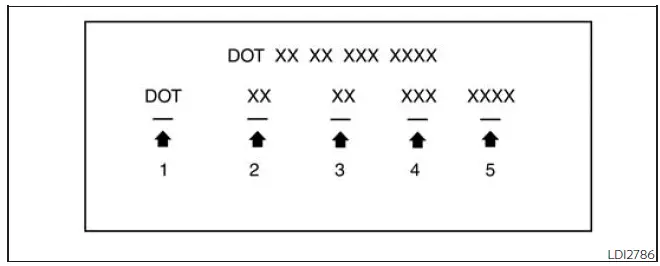
Example (Type A) (if so equipped)
- TIN (Tire Identification Number) for a new tire (example: DOT XX XX XXX XXXX)
1. DOT: This is the abbreviation for the "Department Of Transportation." The DOT symbol may be positioned above, below, to the left, or to the right of the Tire Identification Number.
2. Two-digit code: Manufacturer's identification mark.
3. Two-digit code: Tire size identification.
4. Three-digit code: Tire type code, if provided.
5. Four numbers indicate the week and year the tire was manufactured.
For example, the numbers 3103 mean that the tire was built during the 31st week of 2003.
If these numbers are not visible on one sidewall, check the opposite sidewall of the tire.
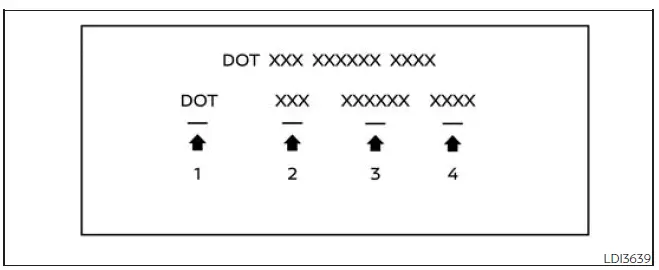
Example (Type B) (if so equipped)
- TIN (Tire Identification Number) for a new tire (example: DOT XXX XXXXXX XXXX)
1. DOT: This abbreviation stands for the "Department Of Transportation." The symbol may appear above, below, or to the left of the Tire Identification Number.
2. Three-digit code: Manufacturer's identification mark.
3. Six-digit code: Descriptive code used to identify important tire characteristics.
4. Four numbers indicate the week and year the tire was manufactured.
For example, the numbers 3103 mean that the tire was manufactured during the 31st week of 2003.
- Tire ply composition and material
This marking identifies the number of layers, or plies, of rubber-coated fabric used in the tire. Tire manufacturers must also list the materials used in the tire construction, such as steel, nylon, polyester, and other reinforcing materials.
- Maximum permissible inflation pressure
This number indicates the highest air pressure that should ever be placed in the tire. Do not exceed the maximum permissible inflation pressure listed on the tire sidewall.
- Maximum load rating
This number shows the maximum load, in kilograms and pounds, that the tire can carry. When replacing tires on the Nissan Frontier, always choose tires with the same load rating as the factory-installed tires or an approved equivalent.
- Term of "tubeless" or "tube type"
This marking indicates whether the tire requires an inner tube ("tube type") or does not require one ("tubeless").
- The word "radial"
The word "radial" appears when the tire is built with radial construction.
- Manufacturer or brand name
The tire manufacturer or brand name is shown on the sidewall.
Other Tire-related Terminology
In addition to the tire terms defined throughout this section, Intended Outboard Sidewall refers to: (1) the sidewall that contains a whitewall, white lettering, or manufacturer, brand, and/or model name molding that is higher or deeper than similar molding on the other sidewall; or (2) the outward-facing sidewall of an asymmetrical tire that must always face outward when installed on the Nissan Frontier.
Understanding tire sidewall markings helps Nissan Frontier owners select the correct replacement tires, confirm load and speed ratings, check tire age, and maintain safe vehicle performance.
Types of tires Nissan Frontier 3rd Gen
Basic information
WARNING
- When changing or replacing tires on the Nissan Frontier, make sure all four tires are the same type, such as Summer, All Season, or Snow, and that they share the same construction. A NISSAN dealer can help provide information about the correct tire type, size, speed rating, load rating, and availability for your vehicle.
- Replacement tires may have a lower speed rating than the tires originally installed at the factory, and they may not match the potential maximum speed capability of the vehicle. Never drive faster than the maximum speed rating of the installed tires.
- Installing tires that were not originally specified by NISSAN may affect the proper operation of the low tire pressure warning system.
- Always use tires of the same type, size, brand, construction, and tread pattern on all four wheels of the Nissan Frontier. Failure to do so may create a difference in tire circumference between the front and rear axles. This can cause the Vehicle Dynamic Control (VDC) system to malfunction, may result in personal injury or death, can lead to excessive tire wear, and may damage the transmission or differential gears.
- For additional tire safety details, refer to "Important Tire Safety Information" (US) or "Tire Safety Information" (Canada) in the Warranty Information Booklet.
All season tires
NISSAN specifies All Season tires on certain Nissan Frontier models to provide balanced performance throughout the year, including acceptable operation in light snow and some icy road conditions.
All Season tires are identified by the markings ALL SEASON and/or M&S on the tire sidewall.
Snow tires generally provide better traction in snow than All Season tires and may be the safer choice in areas with frequent winter storms, packed snow, or prolonged freezing temperatures.
Summer tires
NISSAN specifies summer tires on some models to provide enhanced performance on dry roads in warm weather. However, summer tire performance is significantly reduced on snow, ice, and in very cold conditions.
Summer tires do not display the "M&S" traction marking on the tire sidewall.
If you plan to drive your Nissan Frontier in snowy or icy conditions, NISSAN recommends using SNOW tires or ALL SEASON tires on all four wheels for better traction and more predictable handling.
Snow tires
If snow tires are required, select tires that are equivalent in size and load rating to the original equipment tires. Installing incorrect snow tires can negatively affect Nissan Frontier safety, handling, braking, and stability.
In general, snow tires have lower speed ratings than factory-installed tires and may not match the vehicle’s potential maximum speed. Never exceed the maximum speed rating marked on the tire.
If snow tires are installed, they must be the same size, brand, construction, and tread pattern on all four wheels.
For additional traction on icy roads, studded tires may be used where permitted. However, some U.S.
states and Canadian provinces prohibit or restrict their use. Check local, state, and provincial regulations before installing studded tires on the Nissan Frontier. Studded snow tires may have poorer skid resistance and traction on wet or dry pavement than non-studded snow tires.
Choosing the correct tire type for the season and driving conditions helps the Nissan Frontier maintain safe traction, stable handling, proper TPMS operation, and long-lasting drivetrain performance.
Tire chains Nissan Frontier 3rd Gen
WARNING
If tire chains are used on the Nissan Frontier, they must provide enough clearance between the tire and the nearest suspension, brake, steering, or body component. Using the wrong chains or installing them incorrectly can damage the brakes, suspension, underbody, or other vehicle parts, and may cause a crash in which someone could be seriously injured or killed.
The use of tire chains may be restricted or prohibited in certain areas. Always check local laws before installing tire chains on your Nissan Frontier. When tire chains are required, make sure they are the correct size for the tires installed on the vehicle and that they are fitted exactly according to the chain manufacturer’s instructions. Use only SAE class "S" chains. Class "S" chains are designed for vehicles that have limited clearance between the tires and nearby vehicle components.
Vehicles approved for Class "S" chains are designed to meet the minimum clearance requirements between the tire and the closest suspension or body component needed for winter traction devices, such as tire chains or cables. These clearances are based on the factory-equipped tire size. Other chain types may not fit correctly and may damage the Nissan Frontier.
Use chain tensioners whenever recommended by the tire chain manufacturer to keep the chains tight and properly positioned. Loose end links must be secured or removed to prevent whipping damage to the fenders, wheel wells, suspension components, or underbody. When possible, avoid fully loading the Nissan Frontier while tire chains are installed. Drive at reduced speed and avoid sudden acceleration, hard braking, and sharp steering. Otherwise, vehicle handling, ride quality, and mechanical components may be adversely affected.
Tire chains must be installed only on the rear wheels of the Nissan Frontier. Do not install tire chains on the front wheels.
Do not use tire chains on dry roads. Driving with chains on dry pavement can place excessive stress on tires, wheels, suspension, drivetrain components, and other mechanisms of the vehicle.
Use only the 2WD range when driving on clear paved roads.
For safer winter driving, remove tire chains as soon as they are no longer needed and inspect the tires, wheels, and surrounding areas for any signs of contact or damage after chain use.
Changing wheels and tires Nissan Frontier
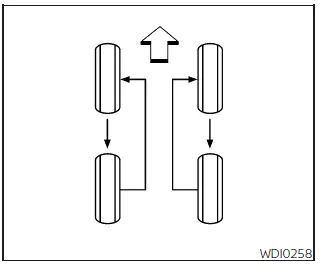
Tire rotation
NISSAN recommends rotating the tires on the Nissan Frontier every 7,500 miles (12,000 km) to help promote more even tread wear and maintain consistent handling performance.
As soon as possible, tighten the wheel nuts to the specified torque with a torque wrench.
Wheel nut tightening torque: 98 ft-lb (133 N·m)
The wheel nuts must be kept tightened to specification at all times.
It is recommended that the wheel nuts be tightened to the specified torque at each tire rotation interval.
WARNING
- After rotating the tires, check and adjust the tire pressure to the recommended cold tire pressure.
- Retighten the wheel nuts after the Nissan Frontier has been driven for 600 miles (1,000 km), including after a flat tire replacement or any wheel removal.
- Do not include the spare tire in the regular tire rotation pattern.
- For additional tire safety information, refer to "Important Tire Safety Information" (US) or "Tire Safety Information" (Canada) in the Warranty Information Booklet.
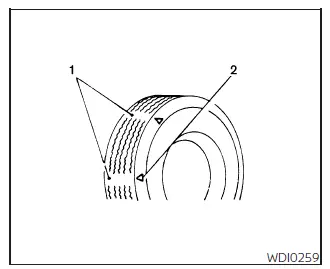
Tire wear and damage
- Wear indicator
- Location mark
WARNING
- Tires should be inspected regularly for tread wear, cracks, bulges, deep cuts, punctures, or foreign objects lodged in the tread. If excessive wear, cracking, bulging, or deep damage is found, the affected tire or tires should be replaced.
- The original tires are equipped with built-in tread wear indicators. When these indicators become visible, the tire tread has worn to the replacement point and the tires should be replaced.
- Tires deteriorate with age as well as use. Have tires, including the spare tire, inspected by a qualified technician if they are more than 6 years old, because some internal or sidewall damage may not be visible. Replace tires as needed to help prevent tire failure and possible personal injury.
- Improper service or repair of the spare tire may result in serious personal injury. If the spare tire requires repair, it is recommended that you visit a NISSAN dealer for this service.
- For additional tire safety information, refer to "Important Tire Safety Information" (US) or "Tire Safety Information" (Canada) in the Warranty Information Booklet.
Replacing wheels and tires
When replacing a tire on the Nissan Frontier, use a tire with the same size, tread design, speed rating, and load-carrying capacity as the tire originally installed on the vehicle.
WARNING
- Using tires other than those recommended by NISSAN, or mixing tires of different brands, construction types (bias, bias-belted, or radial), or tread patterns, can negatively affect ride comfort, braking, handling, Vehicle Dynamic Control (VDC) operation, ground clearance, body-to-tire clearance, tire chain clearance, speedometer accuracy, headlight aim, and bumper height. Some of these effects may lead to an accident and could result in serious personal injury.
- If your Nissan Frontier was originally equipped with four tires of the same size and you are replacing only two of them, install the new tires on the rear axle. Installing new tires on the front axle only may cause loss of vehicle control in certain driving conditions, which could result in an accident and personal injury.
- If the wheels are changed for any reason, always replace them with wheels that have the same offset dimension as the original wheels.
Correct tire rotation, careful tread inspection, and proper wheel and tire replacement help the Nissan Frontier maintain predictable handling, safe braking performance, accurate vehicle systems, and long-lasting tire service life.
Wheels with a different offset may cause premature tire wear, reduce Nissan Frontier handling stability, affect proper VDC system operation, and/or interfere with the brake discs. This type of interference can reduce braking efficiency and may also cause early brake pad wear.
Four-wheel drive models

CAUTION
Always use tires of the same type, size, brand, construction (bias, bias-belted, or radial), and tread pattern on all four wheels of a Nissan Frontier four-wheel drive model. Failure to do so may create a circumference difference between the front and rear tires, causing excessive tire wear and possible damage to the transmission, transfer case, and differential gears.
If excessive tire wear is found, it is recommended that all four tires be replaced with tires of the same size, brand, construction, and tread pattern. Tire pressure and wheel alignment should also be checked and corrected as needed. It is recommended that you visit a NISSAN dealer for this service.
Wheel balance
Unbalanced wheels may negatively affect Nissan Frontier handling, ride comfort, steering feel, and tire life. Even during normal use, wheels can gradually become unbalanced. For this reason, they should be balanced whenever vibration, uneven wear, or other symptoms are noticed.
Wheel balance service should be performed with the wheels removed from the vehicle.
Spin balancing the wheels while they are still mounted on the Nissan Frontier may cause mechanical damage.
- For additional tire safety information, refer to "Important Tire Safety Information" (US) or "Tire Safety Information" (Canada) in the Warranty Information Booklet.
Care of wheels
- Wash the wheels whenever washing the Nissan Frontier to help maintain their appearance and reduce brake dust buildup.
- Clean the inner side of the wheels whenever a wheel is removed or the underside of the vehicle is washed.
- Do not use abrasive cleaners, harsh brushes, or aggressive chemicals when cleaning the wheels.
- Inspect wheel rims regularly for dents, cracks, corrosion, or other damage. Such damage may cause air pressure loss or a poor seal at the tire bead.
- NISSAN recommends waxing the road wheels to help protect against road salt in areas where salt is used during winter.
Proper tire matching, correct TPMS handling, regular wheel balancing, and careful wheel maintenance help preserve Nissan Frontier drivetrain durability, tire life, braking performance, and stable handling in daily driving and four-wheel drive use.
Spare tire (FULL SIZE TEMPORARY USE ONLY spare tire)
When a wheel without TPMS is installed, such as the spare tire, the Tire Pressure Monitoring System will not operate for that wheel.
Your Nissan Frontier may be equipped with a full-size spare tire that differs in size, brand, or specifications from the tires originally installed on the vehicle.
This full-size spare tire is intended for temporary emergency use only and should be replaced with a matching standard tire as soon as possible.
Observe the following precautions whenever the FULL SIZE TEMPORARY USE ONLY spare tire must be installed. Failure to follow these precautions could damage the Nissan Frontier or increase the risk of an accident:
WARNING
To help reduce the risk of a crash that could result in personal injury or death:
- The TEMPORARY FULL SIZE spare tire is intended for emergency use only. Replace it with the standard tire at the first opportunity to help avoid possible tire, drivetrain, or differential damage.
- Drive carefully while the TEMPORARY FULL SIZE spare tire is installed on the Nissan Frontier. Avoid sharp turns, sudden steering inputs, and abrupt braking. Vehicle driving performance may be affected, especially on wet, snowy, icy, or loose road surfaces.
- When the TEMPORARY FULL SIZE spare tire is installed, the Vehicle Dynamic Control (VDC) system will normally not be affected.
- When the TEMPORARY FULL SIZE spare tire is installed, the following systems may not operate
correctly:
- Tire Pressure Monitoring System (TPMS)
- Automatic Emergency Braking (AEB) with Pedestrian Protection
- Periodically check the inflation pressure of the TEMPORARY FULL SIZE spare tire.
Always keep the TEMPORARY FULL SIZE spare tire inflated to the pressure specification shown on the Tire and Loading Information label for the Nissan Frontier.
- With the TEMPORARY FULL SIZE spare tire installed, do not drive faster than 50 mph (80 km/h).
- When driving on snow-covered or icy roads, the TEMPORARY FULL SIZE spare tire should be used on the front wheels, and the original tire should be used on the rear wheels. Use tire chains only on the drive wheels.
- Do not use the TEMPORARY FULL SIZE spare tire from the Nissan Frontier on any other vehicle.
- Do not use more than one TEMPORARY FULL SIZE spare tire at the same time.
- Do not tow a trailer while the TEMPORARY FULL SIZE spare tire is installed.
CAUTION
- Do not install tire chains on a TEMPORARY FULL SIZE spare tire. Tire chains will not fit correctly and may damage the Nissan Frontier.
- Using the TEMPORARY FULL SIZE spare tire on a vehicle equipped with tires larger than the original factory size can affect the 4WD system. A difference in tire circumference between the front and rear axles may cause the 4WD system to automatically place the vehicle in 2WD and flash the 4WD light. When the TEMPORARY FULL SIZE spare tire is replaced with a tire that matches all other tires on the Nissan Frontier, and all tires are properly inflated, the 4WD system will resume normal operation.
For safe operation, use the full-size temporary spare only long enough to reach a repair facility or replace the damaged tire. Restoring a matching tire set helps maintain Nissan Frontier handling, braking, TPMS operation, and four-wheel drive performance.