



Nissan Frontier: In case of emergency - Jump starting
To start the Nissan Frontier engine using a booster battery, carefully follow the procedures and safety precautions below. Jump starting must be performed correctly to protect the vehicle’s electrical system and to prevent personal injury.
WARNING
- If jump starting is performed incorrectly, the battery may explode, which can result in severe injury or death. Incorrect procedures may also cause serious damage to your Nissan Frontier.
- Explosive hydrogen gas is always present near the battery.
Keep sparks, open flames, cigarettes, and other ignition sources away from the battery at all times.
- Do not allow battery fluid to contact your eyes, skin, clothing, or painted surfaces. Battery fluid contains corrosive sulfuric acid and can cause severe burns. If battery fluid contacts any surface or part of the body, immediately flush the affected area with plenty of clean water.
- Keep the battery out of the reach of children.
- The booster battery must be rated at 12 volts. Using a battery with an incorrect voltage rating can damage the Nissan Frontier electrical system.
- Whenever working on or near a battery, always wear proper eye protection, such as safety goggles or industrial safety glasses. Remove rings, watches, metal bands, and other jewelry before handling jumper cables. Do not lean over the battery while jump starting.
- Do not attempt to jump start a frozen battery. A frozen battery can explode and cause serious injury.
- Your Nissan Frontier is equipped with an automatic engine cooling fan. The fan may start operating at any time. Keep hands, clothing, tools, and other objects away from the fan and moving engine components.
WARNING
Always follow the instructions below exactly.
Failure to follow the correct procedure may damage the charging system and may result in personal injury.
1. If the booster battery is installed in another vehicle, position both vehicles so their batteries are close enough for the jumper cables to reach safely.
Do not allow the two vehicles to touch each other.
2. Apply the parking brake firmly. Move the shift lever to P (Park). Turn off all unnecessary electrical systems, including lights, heater, air conditioner, audio system, and other accessories.
3. Place the ignition switch in the LOCK or OFF position.
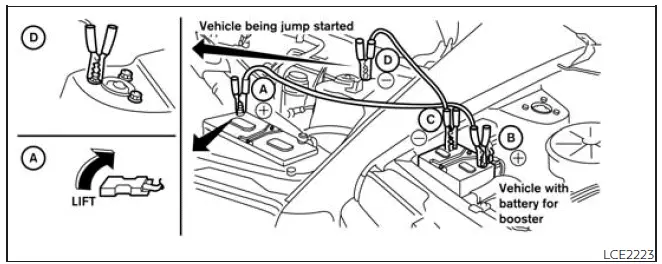
4. Connect the jumper cables in the order shown in the illustration ( A , B , C , D ).
CAUTION
- Always connect positive (+) to positive (+), and connect negative (−) to a suitable body ground, such as a strut mounting bolt, engine lift bracket, or other approved ground point. Do not connect the negative cable directly to the battery.
- Make sure the jumper cables do not contact moving parts in the engine compartment, and ensure that the cable clamps do not touch any unintended metal surfaces.
5. Start the engine of the booster vehicle and allow it to run for several minutes.
6. Keep the booster vehicle engine speed at approximately 2,000 rpm, then start the engine of the Nissan Frontier being jump started.
CAUTION
Do not operate the starter motor for more than 10 seconds at a time. If the engine does not start immediately, turn the ignition switch to the OFF position and wait 3 to 4 seconds before trying again.
7. After the Nissan Frontier engine starts, carefully disconnect the negative cable first, followed by the positive cable. Remove the cables in a controlled manner so the clamps do not touch each other or any metal parts.
After jump starting, allow the engine to run for a period of time so the charging system can help restore battery voltage. If the battery repeatedly becomes discharged, have the battery and charging system inspected.
Push starting
CAUTION
- Do not push start the Nissan Frontier. Push starting may damage the three-way catalyst.
- Automatic transmission models cannot be push-started or tow-started.
Attempting to do so may cause serious transmission damage.
NOTE:
On automatic transmission models, the Malfunction Indicator Light (MIL) may illuminate when low voltage is detected.
This does not affect normal driving functions.
The MIL will turn off after battery voltage returns to a normal value (>12V) and the engine has been started three or more times.